VibeKit
A design intelligence platform that transforms screenshots into production-ready design systems, helping designers and developers move from inspiration to implementation in seconds.
2026
Built
15+
Integrated Tools
Next.js
Framework
Gemini AI
AI Engine
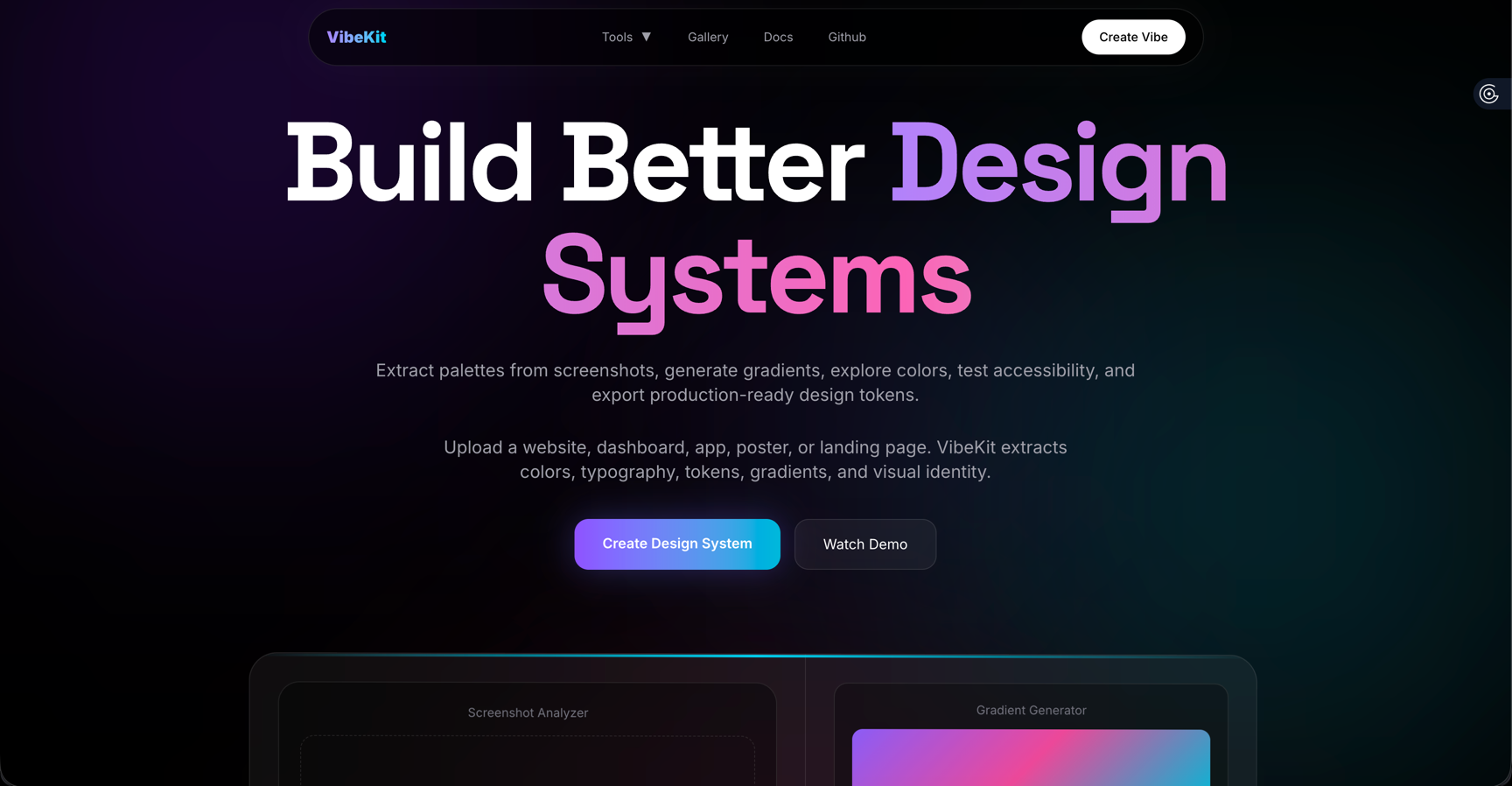
Turning inspiration into production-ready design systems.
Designers rarely begin with a blank canvas. They begin with inspiration—a landing page, dashboard, mobile app, or brand that captures exactly the feeling they want to recreate.
Existing tools usually stop after extracting a few colors, leaving designers and developers to manually build color scales, semantic tokens, accessibility checks, gradients, and implementation-ready themes.
VibeKit bridges that gap by transforming a single screenshot into a complete production-ready design system that developers can immediately build with.
Role
Product Design, Full Stack Development, AI Integration
Timeline
Independent Product
Tech Stack
Next.js, TypeScript, Tailwind CSS, Gemini AI
Focus
Design Systems, Developer Experience, Accessibility
Great interfaces begin with inspiration, but implementation is still manual.
Designers constantly collect screenshots, bookmarks, Dribbble shots, and references, but struggle to transform them into reusable design foundations.
Developers rebuild color scales, semantic tokens, accessibility checks, and themes from scratch—slowing implementation while introducing unnecessary inconsistency.
Instead of generating a palette, VibeKit generates an entire design foundation.
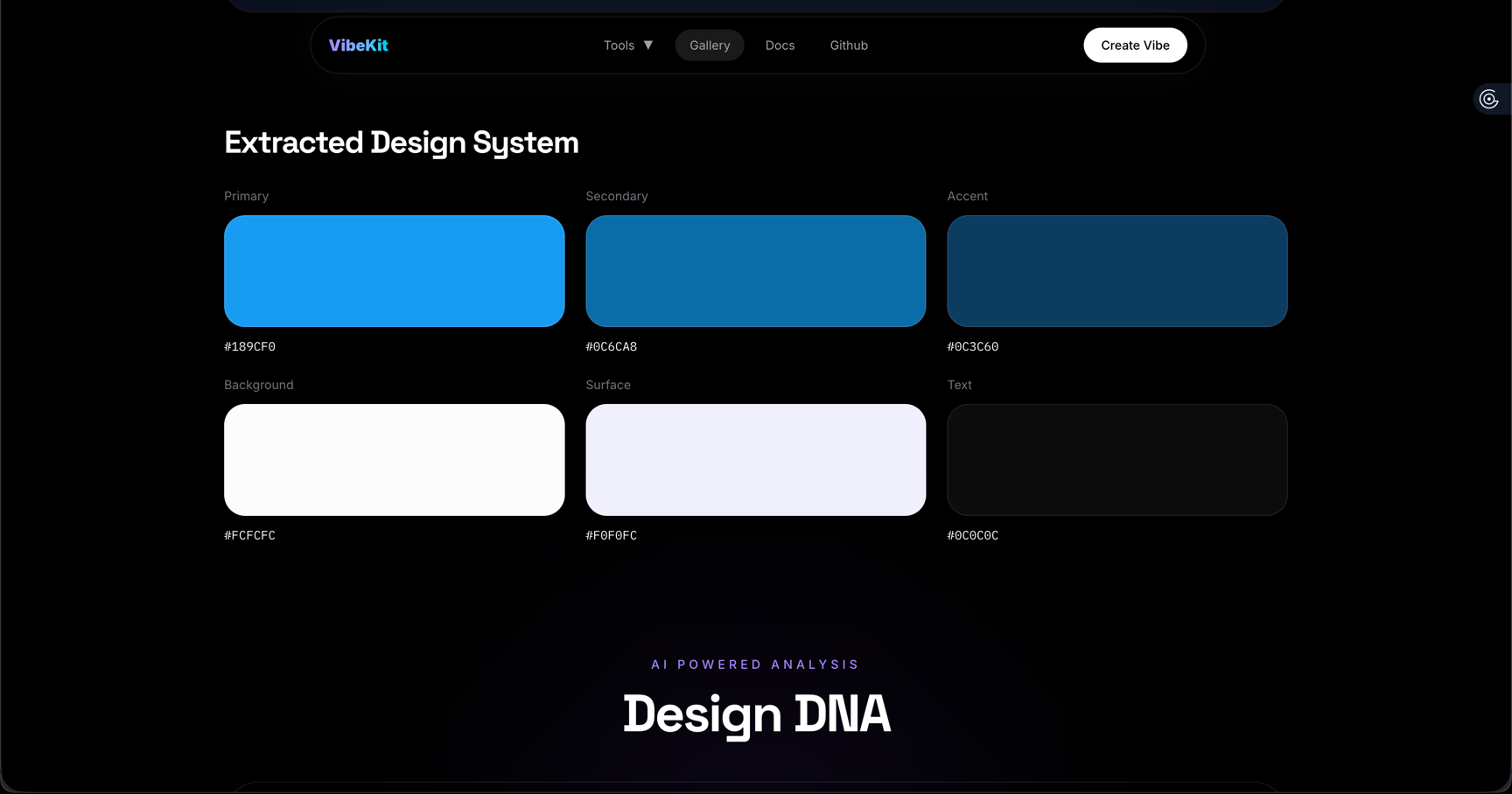
Rather than stopping after extracting a few dominant colors, VibeKit analyzes visual inspiration and transforms it into production-ready assets—including semantic color scales, accessibility reports, gradients, design tokens, CSS variables, and Tailwind themes—from a single screenshot.
Inspiration → Production
01
Upload
Drop any screenshot, landing page, dashboard, or design inspiration.
02
Analyze
Visual hierarchy, dominant colors, composition, and palette relationships are detected.
03
Generate
Color scales, semantic tokens, gradients, accessibility data, and themes are created.
04
Export
Tailwind themes, CSS variables, JSON tokens, and production-ready assets.
05
Build
Developers immediately begin building instead of recreating design systems manually.
Everything needed to move from inspiration to implementation.
Screenshot Analysis
Analyze websites, dashboards, mobile apps, posters, and interfaces to understand their visual language.
Design System Generator
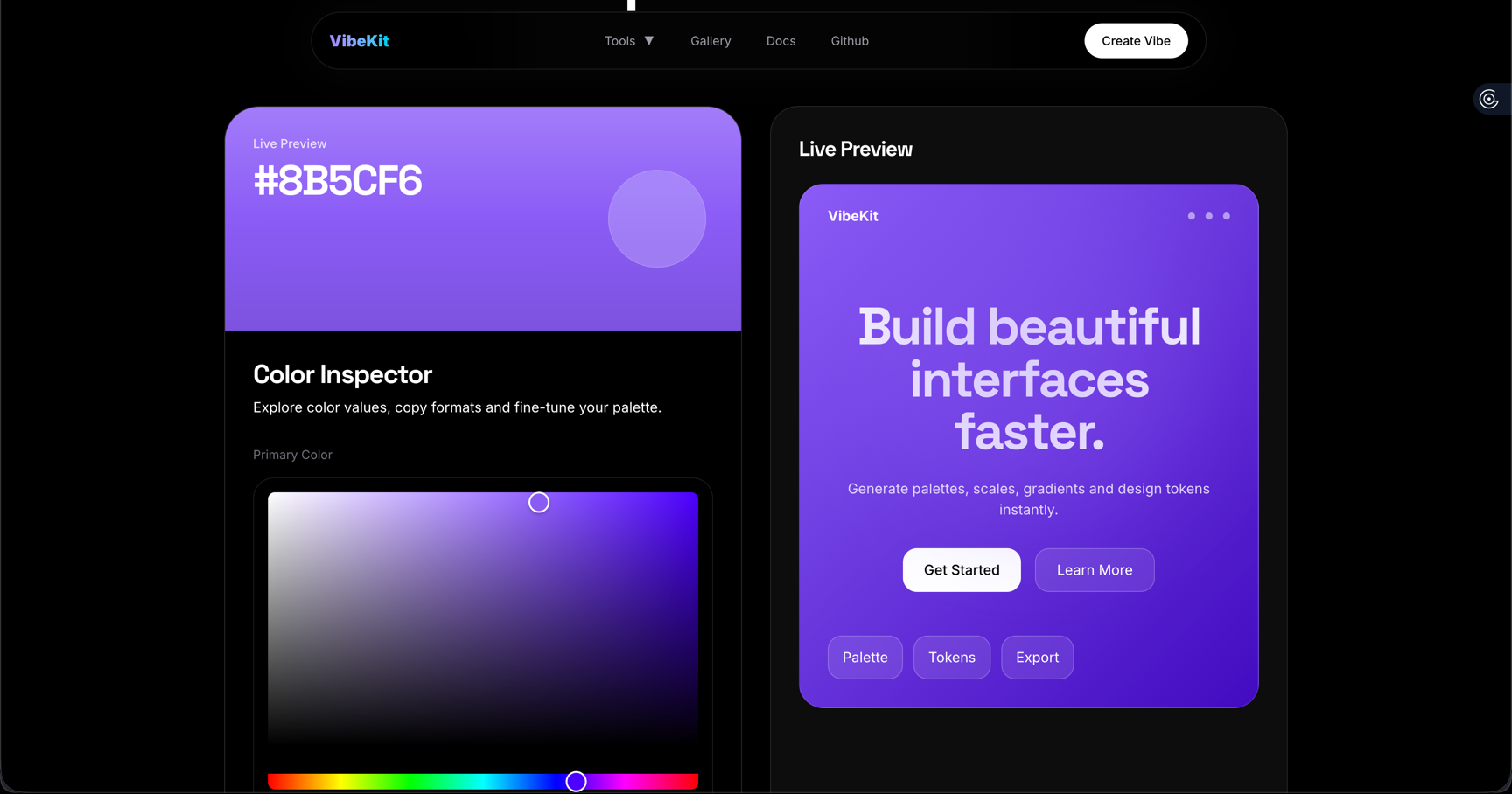
Generate semantic color scales, reusable design tokens, CSS variables, and production themes.
Gradient Studio
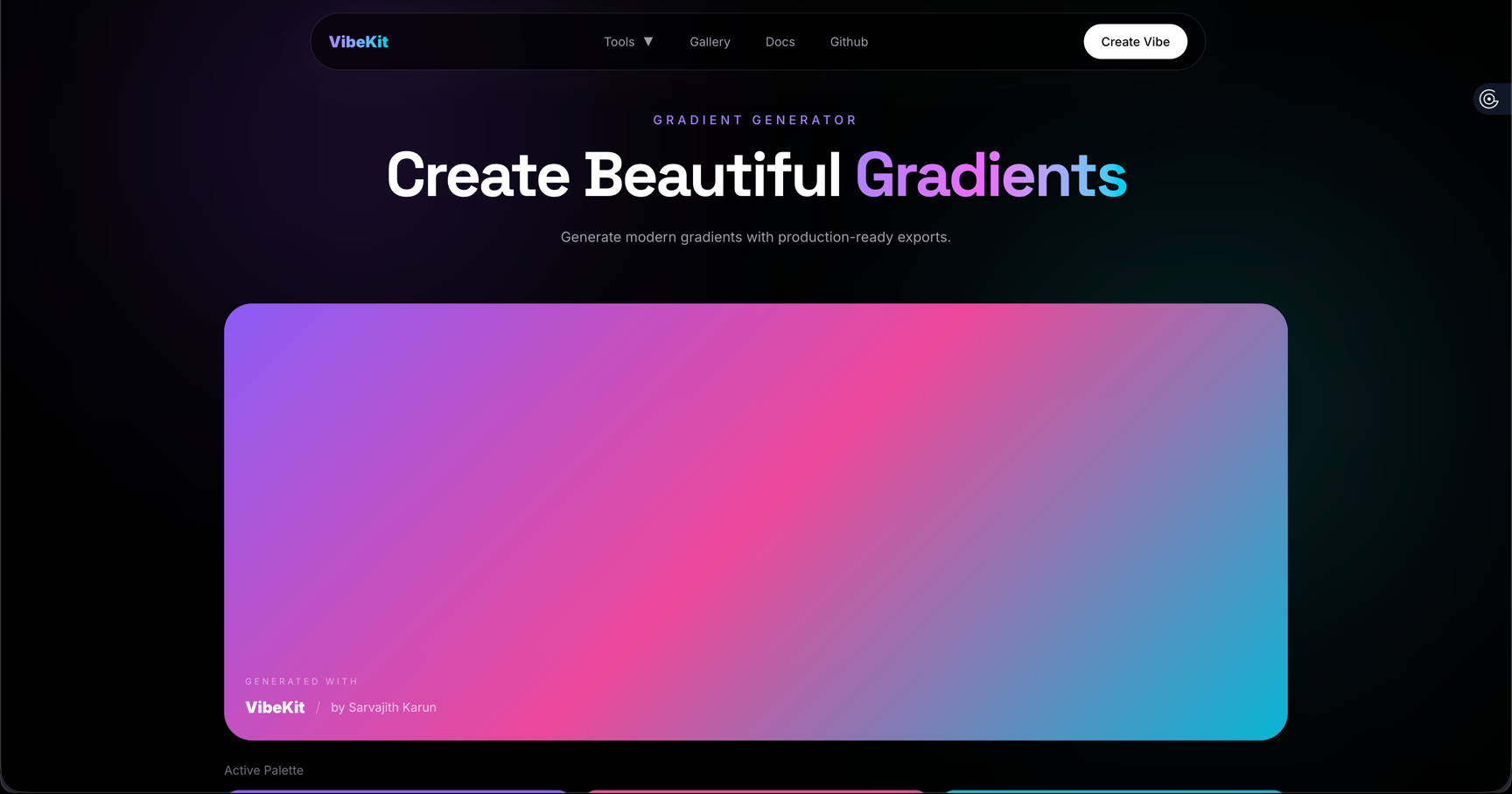
Create linear, radial, conic, and mesh gradients with production-ready exports.
Accessibility Engine
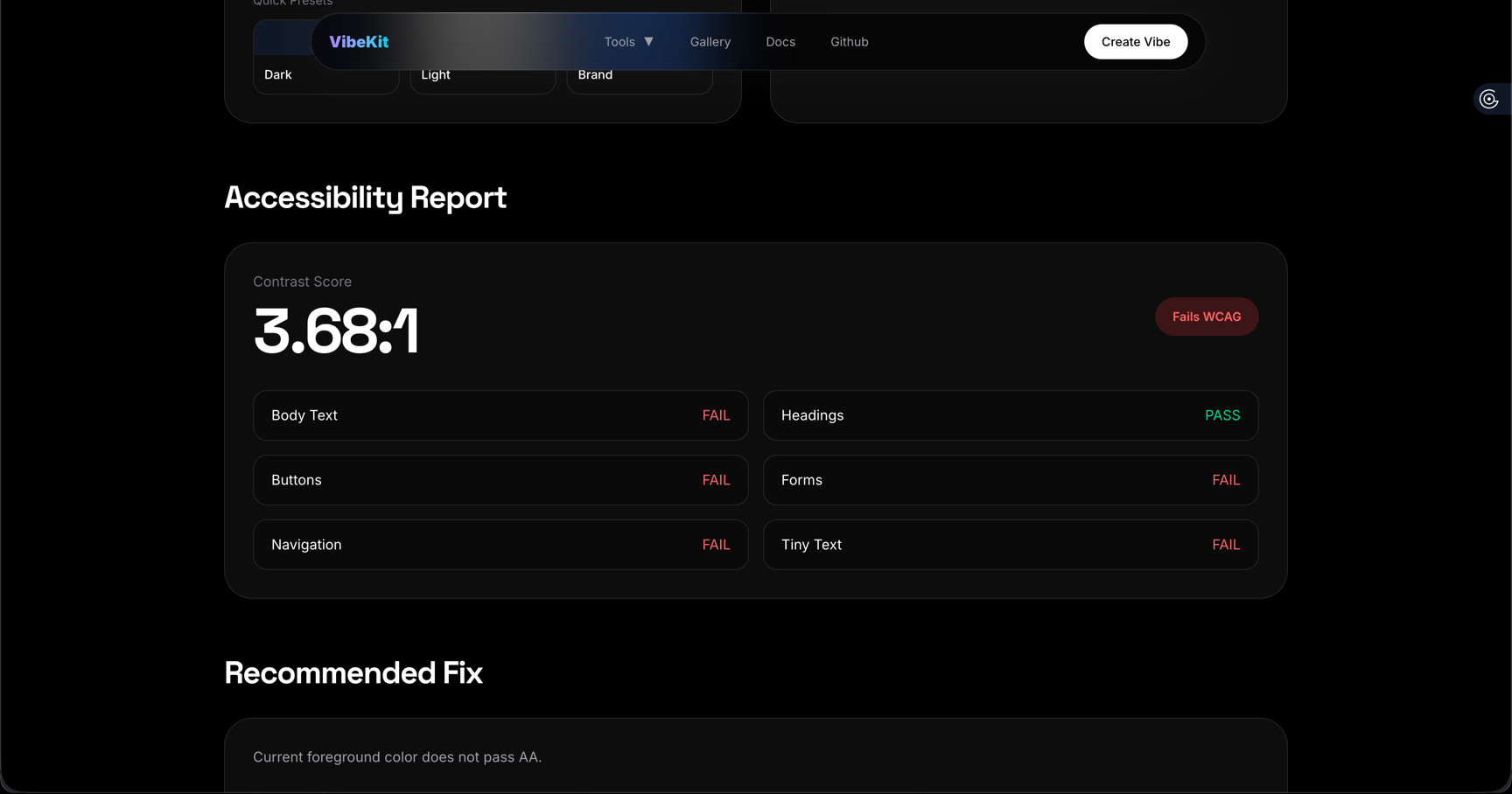
Automatically validate WCAG contrast ratios and generate accessible semantic colors.
Developer Exports
Export Tailwind themes, JSON tokens, CSS variables, and implementation-ready assets.
AI-Assisted Generation
Use Gemini AI to understand visual context and generate smarter, more cohesive design systems.
Built for designers, engineered for developers.
VibeKit wasn't designed as another color extraction tool. The architecture focuses on generating production-ready assets that slot directly into modern frontend workflows.
Every generated palette expands into semantic color scales, accessible design tokens, CSS variables, Tailwind themes, gradients, and reusable exports.
By combining image analysis with AI-assisted processing, VibeKit reduces repetitive work while producing systems that remain consistent across real-world applications.
Tech Stack
Every feature was designed to reduce friction between inspiration and implementation.
Developer First
Every generated result can immediately be used inside real-world projects. Instead of isolated palettes, VibeKit outputs Tailwind themes, CSS variables, JSON tokens, and reusable assets.
Accessible by Default
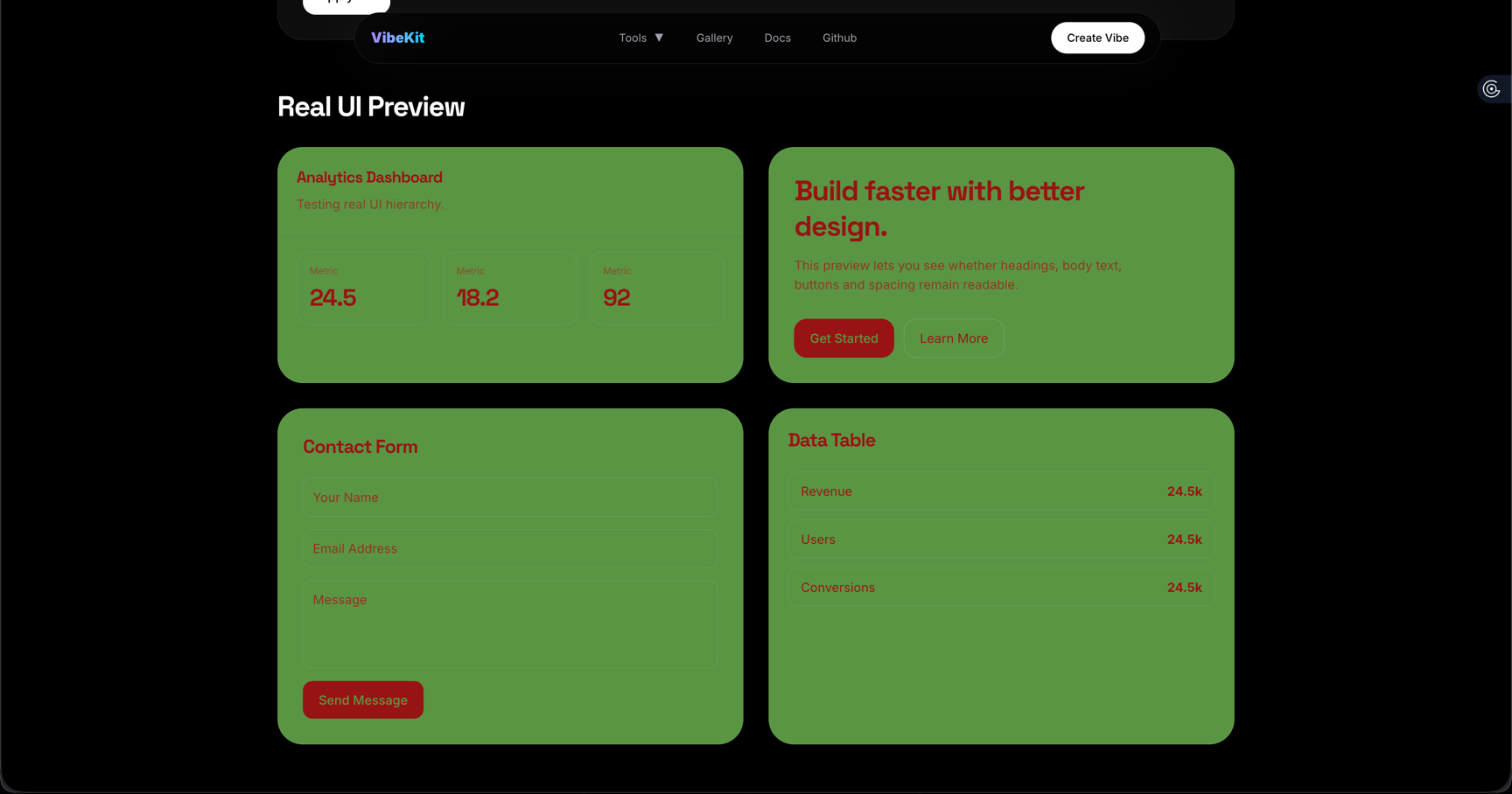
Accessibility isn't treated as an afterthought. Contrast ratios, semantic colors, and scalable palettes are generated as part of the design process.
Visual Intelligence
The platform focuses on understanding the feeling behind a design rather than simply extracting colors, producing systems that feel cohesive instead of random.
Building a system, not just another tool.
One of the biggest engineering challenges was ensuring generated palettes remained visually consistent while producing scalable semantic color systems suitable for production applications.
Another challenge involved balancing automation with creative flexibility. Instead of locking users into predefined outputs, VibeKit provides production-ready foundations while preserving creative control.
The result is a workflow that dramatically reduces repetitive design system work without sacrificing design quality.
Project Highlights
15+
Integrated Design Tools
100%
Responsive Interface
AI
Gemini-powered Analysis
∞
Generated Design Systems
Inside the platform.